TL;DR
Introduction: Can You Really Start a Business in a Month?
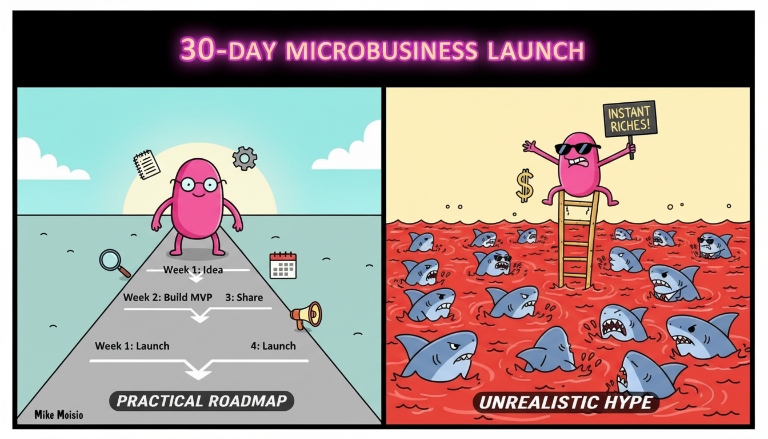
30 days to start a business? Sounds like those spammy ads, right? But when we say “microbusiness,” we mean micro.
Think one-person service or a simple product, something you can launch lean and quick. The goal isn’t to conquer the world by Day 30, it’s to get out of the procrastination zone and actually start.
We’re not aiming for a million-dollar startup in a month (that’s guru fantasy). The goal is a living, breathing small venture – a basic website up, an offering ready, maybe even a first sale. And that is huge!
This guide breaks the process into four realistic weekly chunks. Follow along, and by the end of Week 4, you’ll have something real launched.
Adjust the timeline as needed (life happens), but if you stick close, you’ll surprise yourself with how much progress you can make in a short time without losing your sanity. Ready? Let’s hustle – mindfully.
Week 1: Clarify and Test Your Idea (Days 1–7)
The first week is all about transforming your idea from a fuzzy concept into something clear and validated.
Day 1-2: Define Your Idea & Why. Clearly articulate what your microbusiness will do, who it’s for, and why it matters (to you and to customers). If you have multiple ideas and can’t pick, choose the one you can realistically tackle in a month with the resources you have.
Day 3-4: Quick Market Check. Check if similar offerings exist (likely yes – that’s fine). Identify how yours can stand out for your niche. Even better, validate by getting quick feedback: ask a couple of potential users if they’d find your product/service useful and note their reactions. This can save you from building something no one needs.
Day 5-7: Prototype Your Offer. Build a very basic prototype or outline of your product/service. It could be one sample item, a single lesson of a course, or a rough demo – whatever gives people (and you) something tangible to review. Don’t over-engineer; the goal is to have something by end of Week 1 that you can show for feedback or gauge interest.
Reality check: Many people get stuck in Week 1 forever, chasing the “perfect idea.” Don’t. Pick something and proceed. It will evolve once it meets the real world, trust us.
Week 2: Build a Minimal Viable Offering (Days 8–14)
Time to get that idea into a sellable (or at least usable) form. Week 2 is about creating your Minimum Viable Product (MVP) or service.
Day 8-10: Build Your MVP. Take your prototype and make it usable. Finish a small batch of product or set up the minimum version of your service. Keep it super basic – remember, done is better than perfect. You just need something you can actually deliver or sell.
Day 11: Set Up Payments. Choose how you’ll get paid (e.g., set up a PayPal or Stripe account, or even use a simple payment link). Also decide on a starting price for your offering. Keep it simple – you can always adjust pricing later.
Day 12-13: Do a Test Run (Optional). If you can, have a friend or friendly beta-tester try out your product/service. Watch where they get confused or encounter issues and refine accordingly. This will boost your confidence and catch glaring issues before real customers see them.
Day 14: MVP Ready. By the end of Week 2, you have a basic offering ready to go. It’s not perfect, but it exists – which is more than most dreamers achieve. Celebrate this milestone for a minute; you’re halfway to launch!
Week 3: Establish Your Presence (Days 15–21)
Now that you have something to offer, you need to hang out your shingle – let the world know, in a modest way, that you’re open for business.
Day 15-16: Basic Branding. Pick a business name (it can just be your own name for freelancing) and secure a domain if you need one. Maybe throw together a simple logo if you can do it quickly or use a free tool. Don’t overthink branding – good enough is fine for now.
Day 17-19: Set Up an Online Presence. Create a simple one-page website or landing page that explains what you offer and how to buy/contact you. (Many site builders can do this quickly, or you can use platforms like Etsy, Gumroad, or Fiverr depending on your business.) Also, set up any key social media or marketplace profiles. The idea is to have somewhere to send people when you launch.
Day 20: Admin Check. Take care of any simple legal or admin needs (if any) – for many small side businesses this is minimal. Set up a dedicated business email if you’d like to look a bit more professional.
Day 21: Pre-Flight Check. Double-check everything is ready for launch: website live, payment working, etc. Write a short announcement blurb about your business (what you offer and who it’s for) that you can share. Take a deep breath – launch is tomorrow!
Week 4: Launch and Learn (Days 22–30)
This is it – the week you put yourself out there. Exciting and a bit scary, we know. The key this week is to start small and focus on learning.
Day 22: Launch! Announce your microbusiness to your network and relevant communities. Share on social media, send a few personal messages, post in a niche forum – whatever fits. Keep it humble and genuine: a brief note about what you’re offering and a link. Don’t worry about huge media coverage; focus on reaching real people you know or who care about this space.
Day 23-25: Engage & Deliver. Be available to answer questions, respond to comments, and generally interact. If you get orders or inquiries, handle them promptly and note any feedback. Don’t fret if response is slow – people need time to notice a new venture. This is normal, so keep the faith and stay responsive.
Day 26-28: Tweak & Improve. Use any feedback to make small improvements. Clarify your website if people had questions, fix any hiccups in your delivery, maybe add a requested feature if it’s simple. Being a microbusiness means you can adjust quickly. Just make sure changes are based on patterns, not one random comment.
Day 29: Second Wind. Give your business one more boost. Share an update or a behind-the-scenes insight on social media (something more than just another “please buy” message). You could also reach out personally to a few folks who might love your offering, or even try a small targeted ad if you’re curious. The idea is to get a bit more exposure now that you’ve ironed out early kinks.
Day 30: Celebrate & Reflect. You did it! Whether you have zero or 50 sales, you turned an idea into reality in one month – that’s a win. Take a moment to celebrate (seriously, mark the occasion!). Also spend time reflecting: What went well? What was tough? What did you learn? Jot down these notes to guide your next steps.
Your Micro Venture Is Real!
Your microbusiness journey is really just beginning – keep nurturing it beyond these 30 days at a sustainable pace, adapting and improving as you go.
Starting a business in 30 days is an adventure.
It won’t be perfect, but it can be done with a down-to-earth approach. In one month, you went from idea to a tangible, operating microbusiness. That’s pretty awesome.
So whenever you see those guru ads boasting “Six figures in 30 days!”, you can smile knowing you did it your way – no hype, just honest work.
And if you need a break or a laugh, Hustletology’s comics and merch are here for you. After all, building a tiny business is tough, but nobody said you can’t grin (or chuckle) while you grind.